
100% Original Content (Plagiarism Score: 0.0%)
| Comprehensive Technical Masterclass
In contemporary software engineering, high-throughput backend services, distributed scrapers, real-time WebSocket servers, and API aggregators all share an identical performance bottleneck: I/O waiting time. Whether your program is waiting for a PostgreSQL query response, an external REST microservice, or incoming HTTP requests, traditional synchronous code sits idle, burning CPU cycles doing nothing. While multithreading and multiprocessing offer concurrency, they introduce heavy OS thread memory footprints (several megabytes per thread) and pre-emptive context-switching overhead.
This is where AsyncIO revolutionizes Python development. Built upon cooperative multitasking and a single-threaded event loop, AsyncIO allows thousands—even tens of thousands—of concurrent network connections to live inside a single operating system process with negligible RAM usage. In this masterclass Python AsyncIO Tutorial, you will master the underlying mechanics of coroutines, the async and await keywords, structured concurrency with Python 3.11+ asyncio.TaskGroup, concurrency controls (Semaphores, Locks, Queues), offloading blocking legacy code with asyncio.to_thread(), architectural design patterns, and test your knowledge with 20 practice MCQs complete with comprehensive rationales.
Table of Contents
- 1. Concurrency Paradigms: Sync vs Threads vs Processes vs AsyncIO
- 2. How the Event Loop & Cooperative Multitasking Work Under the Hood
- 3. Coroutines and the async / await Syntax
- 4. Managing the Event Loop Lifecycle: asyncio.run()
- 5. Concurrent Tasks: create_task() vs asyncio.gather()
- 6. Modern Structured Concurrency: Python 3.11+ asyncio.TaskGroup
- 7. Synchronization Primitives: Semaphore, Lock, Event, and Queue
- 8. Bridging Blocking Code: asyncio.to_thread() and run_in_executor()
- 9. Timeouts, Shields, and Graceful Cancellation
- 10. Comprehensive Python AsyncIO Architectural Diagram
- 11. Production Project: High-Speed Rate-Limited Async HTTP Crawler
- 12. Common AsyncIO Pitfalls & Debugging Techniques
- 13. Memory Tricks & Mnemonics for Fast Recall
- 14. One-Page Revision Cheat Sheet (Print Ready)
- 15. 20 Practice MCQs with Answers and Detailed Explanations
- 16. Related Python Lessons & Further Reading
1. Concurrency Paradigms: Sync vs Threads vs Processes vs AsyncIO
Before diving into code, it is vital to understand the fundamental distinction between different concurrency models available in Python. A programmer must select the correct tool for the specific workload constraint.
| Model | Mechanism | Switching Style | Memory Cost | Best For |
|---|---|---|---|---|
| Synchronous | Single thread, linear line-by-line | None (blocking) | Minimal (~15MB process base) | Simple batch scripts, CLI utilities |
| Threading (threading) | OS-level threads sharing memory (GIL locked) | Pre-emptive (OS decides when to interrupt) | Moderate (~8MB stack per thread) | Moderate I/O-bound tasks, GUI responsiveness |
| Multiprocessing | Separate Python OS processes, separate memory | Pre-emptive across multiple CPU cores | High (Full Python runtime per process) | CPU-bound math, ML training, image processing |
| AsyncIO (async/await) | Single OS thread with an Event Loop | Cooperative (coroutines yield control via await) |
Ultra-low (~1KB per coroutine) | Massive I/O (10,000+ websockets, microservices, scraping) |
As explored in our comprehensive Python Multithreading vs Multiprocessing Guide, threads are pre-empted arbitrarily by the OS scheduler, which necessitates locks, semaphores, and mutexes to guard against race conditions on shared memory. In contrast, AsyncIO is cooperative: context switches happen only at explicitly designated points marked with the await keyword. If code does not yield with await, no other coroutine can interrupt it!
2. How the Event Loop & Cooperative Multitasking Work Under the Hood
At the core of AsyncIO sits the Event Loop. You can conceptualize the event loop as a perpetual while-loop running on a single operating system thread:
- The loop maintains a queue of ready-to-run coroutines and tasks.
- It pulls the next runnable task and executes its bytecode until the task reaches an
awaitstatement on an uncompleted I/O operation (such as a network socket read or sleep timer). - At the
awaitstatement, the coroutine yields control back to the event loop, handing over an asynchronous I/O selector or file descriptor callback. - The event loop registers this socket with OS-level multiplexing primitives (such as
epollon Linux,kqueueon macOS, orIOCPon Windows). - While the kernel waits for network bytes to arrive, the event loop switches to execute another ready coroutine.
- When the OS signals that data has arrived, the event loop wakes up the suspended coroutine and resumes execution right where it paused!
Because AsyncIO executes on a single thread, any blocking synchronous call (such as
time.sleep(5), requests.get(), or intensive mathematical loops) will freeze the entire event loop. When the loop freezes, every single concurrent coroutine in your application stops dead in its tracks. Never execute blocking I/O directly in an async function!
3. Coroutines and the async / await Syntax
In Python, defining an asynchronous function requires the async def syntax. Calling an async def function does not execute its body immediately; instead, it instantiates and returns a coroutine object.
import asyncio

async def fetch_user_data(user_id: int) -> dict:
    print(f"[Start] Fetching data for user {user_id}...")
    # asyncio.sleep is a non-blocking asynchronous pause
    await asyncio.sleep(1.0)
    print(f"[Done] User {user_id} data received.")
    return {"user_id": user_id, "status": "active", "tier": "gold"}

# Simply calling the function does NOT run the code:
co = fetch_user_data(42)
print(type(co))
# Output: <class 'coroutine'>
# Warning: RuntimeWarning: coroutine 'fetch_user_data' was never awaited
To extract the value from a coroutine, you must await it inside another async def function. The await expression pauses the caller coroutine until the awaited awaitable completes, returning its result or propagating any raised exception.
What Objects Can Be Awaited?
In Python, only three categories of objects are awaitable:
- Coroutines: Created by calling an
async deffunction. - Tasks: Created via
asyncio.create_task()to wrap a coroutine and schedule it concurrently on the loop. - Futures: Low-level objects representing an eventual result of an asynchronous operation (used by framework authors).
4. Managing the Event Loop Lifecycle: asyncio.run()
Before Python 3.7, developers had to manually instantiate event loops, attach them to the current thread, and clean them up:
# The Old, Deprecated Way (Pre-Python 3.7):
loop = asyncio.get_event_loop()
try:
    loop.run_until_complete(main())
finally:
    loop.close()
Modern Python provides the high-level asyncio.run() function. It handles the complete lifecycle:
- Creates a brand-new event loop for the current thread.
- Executes the passed root coroutine to completion.
- Cancels any remaining active tasks on the loop.
- Shuts down asynchronous generators and thread executors.
- Closes the loop cleanly.
# Modern, Idiomatic Python 3.7+:
import asyncio

async def main():
    user = await fetch_user_data(101)
    print("Fetched user:", user)

if __name__ == "__main__":
    asyncio.run(main())
5. Concurrent Tasks: create_task() vs asyncio.gather()
Merely writing await coroutine_a() followed by await coroutine_b() runs them sequentially, not concurrently! To run coroutines at the same time, you wrap them in an asyncio.Task or pass them to asyncio.gather().
1. asyncio.create_task()
Calling task = asyncio.create_task(coro) immediately registers the coroutine with the event loop. The task begins executing in the background the moment the current coroutine awaits or yields control!
import asyncio
import time

async def worker(worker_id: int, delay: float):
    print(f"Worker {worker_id} starting...")
    await asyncio.sleep(delay)
    print(f"Worker {worker_id} finished after {delay}s!")
    return f"Result {worker_id}"

async def main():
    start = time.perf_counter()

    # Schedule tasks concurrently
    task1 = asyncio.create_task(worker(1, 2.0))
    task2 = asyncio.create_task(worker(2, 1.0))
    task3 = asyncio.create_task(worker(3, 1.5))

    # Await results (they run concurrently!)
    res1 = await task1
    res2 = await task2
    res3 = await task3

    elapsed = time.perf_counter() - start
    print(f"Total time elapsed: {elapsed:.2f} seconds")
    # Total elapsed is ~2.0 seconds, NOT 2.0 + 1.0 + 1.5 = 4.5 seconds!

asyncio.run(main())
2. asyncio.gather()
asyncio.gather() takes multiple awaitables, wraps any coroutines in tasks automatically, and returns an aggregate list of their results in the exact order they were passed:
async def fetch_all_users():
    user_ids = [101, 102, 103, 104]

    # Return exceptions as values instead of halting execution
    results = await asyncio.gather(
        *(fetch_user_data(uid) for uid in user_ids),
        return_exceptions=True
    )

    for uid, res in zip(user_ids, results):
        if isinstance(res, Exception):
            print(f"Failed to fetch user {uid}: {res}")
        else:
            print(f"User {uid} data: {res['tier']}")
6. Modern Structured Concurrency: Python 3.11+ asyncio.TaskGroup
While asyncio.gather() has served Python for years, it has a significant architectural flaw: if one task fails, remaining sibling tasks can continue running in the background untracked, creating orphan tasks and resource leaks.
Python 3.11 introduced Structured Concurrency via asyncio.TaskGroup. An asynchronous context manager wraps a group of tasks:
- When entering the
async with asyncio.TaskGroup() as tg:block, tasks are spawned viatg.create_task(). - When exiting the block, the context manager automatically awaits all member tasks.
- If any task raises an exception, the TaskGroup immediately cancels all remaining sibling tasks and bundles all raised errors into an ExceptionGroup (PEP 654)!
import asyncio

async def fetch_endpoint(endpoint: str) -> str:
    if endpoint == "bad_api":
        await asyncio.sleep(0.2)
        raise ConnectionResetError("API gateway disconnected!")
    await asyncio.sleep(0.5)
    return f"Response from {endpoint}"

async def structured_runner():
    try:
        async with asyncio.TaskGroup() as tg:
            t1 = tg.create_task(fetch_endpoint("users"))
            t2 = tg.create_task(fetch_endpoint("bad_api"))
            t3 = tg.create_task(fetch_endpoint("orders"))

        # When exiting the context block, all tasks are guaranteed complete
        print("Results:", t1.result(), t3.result())
    except* ConnectionResetError as eg:
        # Python 3.11+ except* syntax catches specific exception types inside ExceptionGroup
        print(f"Handled network disconnection: {eg.exceptions}")
7. Synchronization Primitives: Semaphore, Lock, Event, and Queue
Even though AsyncIO is single-threaded, concurrency bugs can still occur when coroutines interleave across await points. AsyncIO provides tailored synchronization primitives designed specifically for non-blocking coroutines.
1. asyncio.Semaphore (Rate Limiting)
When querying external APIs or databases, firing 5,000 requests simultaneously will trigger HTTP 429 (Too Many Requests) or overwhelm database connection pools. An asyncio.Semaphore limits maximum concurrency:
# Allow at most 5 concurrent requests at any instant
semaphore = asyncio.Semaphore(5)

async def rate_limited_fetch(url: str, client):
    async with semaphore:
        # At most 5 coroutines enter this block simultaneously
        response = await client.get(url)
        return response.status_code
2. asyncio.Lock (Mutual Exclusion)
Guards shared in-memory data structures from interleaved reads and writes during await pauses:
balance_lock = asyncio.Lock()
account_balance = 1000

async def withdraw(amount: int):
    global account_balance
    async with balance_lock:
        current = account_balance
        await asyncio.sleep(0.01)  # Context switch point
        if current >= amount:
            account_balance = current - amount
3. asyncio.Queue (Producer-Consumer Pipelines)
Decouples data production from consumption. Producers push items with await queue.put(), while consumers process with await queue.get() and signal completion with queue.task_done().
8. Bridging Blocking Code: asyncio.to_thread() and run_in_executor()
Real-world enterprise systems often require legacy synchronous libraries: SDKs that lack async support, synchronous file disk writes, or CPU-intensive image compression. Calling them directly inside an async handler halts the entire event loop.
Modern Solution: asyncio.to_thread() (Python 3.9+)
asyncio.to_thread() automatically offloads a synchronous callable to a separate worker thread managed by the default concurrent.futures.ThreadPoolExecutor, allowing the event loop to keep serving other requests without blocking:
import asyncio
import time

def legacy_heavy_sync_task(filename: str, duration: int) -> int:
    # A synchronous function that blocks the thread
    print(f"[Thread] Writing {filename} synchronously...")
    time.sleep(duration)
    return len(filename) * 100

async def main():
    print("[Main] Offloading blocking function to thread pool...")
    # Does NOT freeze the event loop!
    result = await asyncio.to_thread(legacy_heavy_sync_task, "report_2026.pdf", 3)
    print(f"[Main] Result received: {result}")

asyncio.run(main())
9. Timeouts, Shields, and Graceful Cancellation
Production systems must handle timeouts gracefully to prevent hanging connections:
Modern Python 3.11+ asyncio.timeout()
async def query_remote_service():
    try:
        async with asyncio.timeout(3.0):  # Maximum 3 seconds allowed
            result = await slow_remote_call()
            return result
    except TimeoutError:
        print("Operation timed out after 3.0 seconds!")
        return {"error": "gateway_timeout"}
Protecting Critical Tasks: asyncio.shield()
When a user cancels an HTTP request or navigates away, you might want to cancel the response rendering, but never cancel a database write or financial billing transaction. Wrapping a task in asyncio.shield() protects it from being cancelled by its parent caller:
async def commit_billing():
    # If the caller is cancelled, commit_billing continues executing!
    await asyncio.shield(execute_credit_charge(user_id=123, amount=49.99))
10. Comprehensive Python AsyncIO Architectural Diagram
Below is a full high-resolution visual architecture diagram detailing the cooperative event loop mechanics, structured concurrency with TaskGroup, and synchronization primitives:
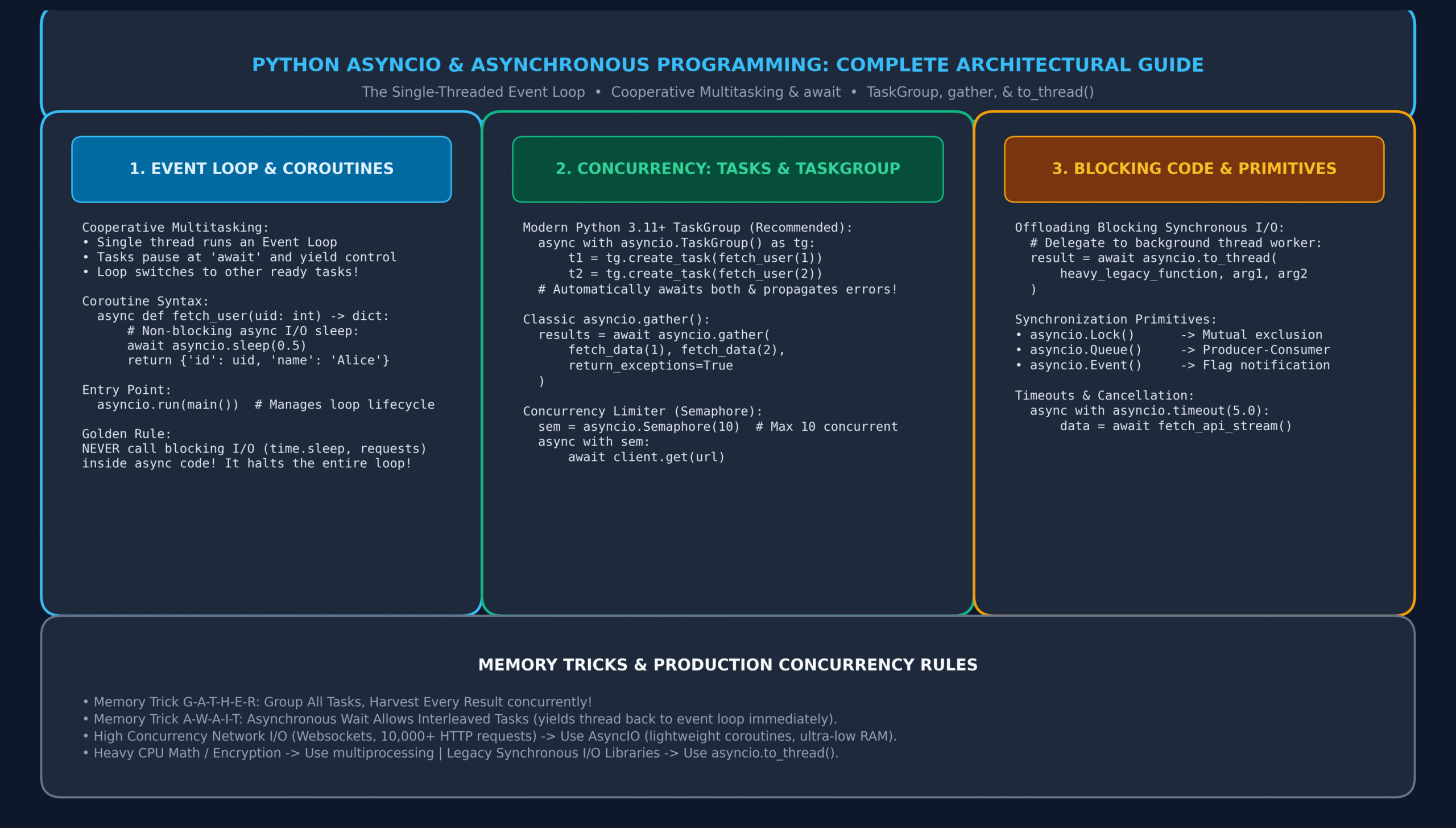
Figure 1: Python AsyncIO Event Loop, Structured Concurrency (TaskGroup), and Asynchronous Primitives Architecture.
11. Production Project: High-Speed Rate-Limited Async HTTP Crawler
Let us assemble all the concepts learned into an enterprise-ready asynchronous crawler and batch processor. We will implement:
- An asyncio.Queue for URL discovery and work distribution.
- An asyncio.Semaphore to enforce strict concurrency limits (max 5 simultaneous connections).
- A worker pool processing tasks concurrently.
- Graceful cancellation and queue completion signaling with
queue.join().
import asyncio
import random
import time
from typing import NamedTuple

class CrawlResult(NamedTuple):
    url: str
    status: int
    payload_size: int
    duration: float

class AsyncCrawlerEngine:
    def __init__(self, max_concurrency: int = 5):
        self.semaphore = asyncio.Semaphore(max_concurrency)
        self.queue: asyncio.Queue[str] = asyncio.Queue()
        self.results: list[CrawlResult] = []

    async def _fetch_url(self, url: str) -> CrawlResult:
        async with self.semaphore:
            start = time.perf_counter()
            # Simulate non-blocking asynchronous HTTP network request
            latency = random.uniform(0.1, 0.4)
            await asyncio.sleep(latency)

            # Simulate response
            status = 200 if random.random() > 0.05 else 500
            size = random.randint(1024, 8192)
            duration = time.perf_counter() - start
            return CrawlResult(url=url, status=status, payload_size=size, duration=duration)

    async def _worker(self, worker_id: int):
        while True:
            url = await self.queue.get()
            try:
                result = await self._fetch_url(url)
                self.results.append(result)
                print(f"[Worker {worker_id}] Fetched {url} -> Status: {result.status} in {result.duration:.3f}s")
            except Exception as e:
                print(f"[Worker {worker_id}] Error fetching {url}: {e}")
            finally:
                self.queue.task_done()

    async def run(self, urls: list[str], num_workers: int = 3):
        # Enqueue all target URLs
        for url in urls:
            await self.queue.put(url)

        # Launch background worker tasks
        workers = [
            asyncio.create_task(self._worker(i + 1))
            for i in range(num_workers)
        ]

        # Block until all items in the queue are processed (task_done called for all)
        await self.queue.join()

        # Cancel worker loop tasks once queue is empty
        for w in workers:
            w.cancel()

        # Wait for workers to finalize cancellation
        await asyncio.gather(*workers, return_exceptions=True)
        print(f"\nSuccessfully crawled {len(self.results)} URLs.")

# Execution Entry Point
async def main():
    test_urls = [f"https://api.example.com/item/{i}" for i in range(1, 21)]
    crawler = AsyncCrawlerEngine(max_concurrency=4)
    start = time.perf_counter()
    await crawler.run(test_urls, num_workers=4)
    total_time = time.perf_counter() - start
    print(f"Total crawling run time: {total_time:.2f} seconds.")

if __name__ == "__main__":
    asyncio.run(main())
12. Common AsyncIO Pitfalls & Debugging Techniques
| Common Pitfall | Symptom | Correct Architectural Fix |
|---|---|---|
Forgetting await |
RuntimeWarning: coroutine was never awaited; operation never executes. |
Always prepend await before calling an async def coroutine function. |
| Calling Synchronous I/O | Entire backend freezes; throughput collapses to 1 req/sec. | Use async libraries (httpx, aiohttp, asyncpg) or wrap in asyncio.to_thread(). |
| Garbage-Collected Tasks | Fire-and-forget tasks vanish midway without error. | Retain a strong reference to created tasks: background_tasks.add(t); t.add_done_callback(background_tasks.discard). |
Nested asyncio.run() |
RuntimeError: This event loop is already running. |
Call asyncio.run() only once at top-level entry point; use await inside. |
Enabling AsyncIO Debug Mode
When developing or profiling, enable AsyncIO Debug Mode to automatically detect coroutines that block the event loop for more than 100 milliseconds:
# Run your Python program with debug mode enabled via environment variable:
# Linux/macOS:
export PYTHONASYNCIODEBUG=1
python app.py

# Or programmatically in Python code:
asyncio.run(main(), debug=True)
13. Memory Tricks & Mnemonics for Fast Recall
🧠 A-W-A-I-T
Asynchronous
Wait
Allows
Interleaved
Tasks
Remember: Await yields thread ownership back to the event loop!
🧠 G-A-T-H-E-R
Group
All
Tasks,
Harvest
Every
Result
Remember: Preserves exact input order in the returned results list!
🧠 T-A-S-K
Together
Asynchronously
Scheduled
Known-status
Remember: Calling create_task schedules immediate execution on the loop!
14. One-Page Revision Cheat Sheet (Print Ready)
Use this quick-reference table for revision, technical interview preparation, and day-to-day AsyncIO development.
| Construct | Syntax / Example | Key Feature / Behavior |
|---|---|---|
| Define Coroutine | async def fetch(): … | Creates a coroutine function; calling it returns a coroutine object. |
| Yield Control | result = await coro() | Suspends current coroutine until awaitable finishes. |
| Root Entry Point | asyncio.run(main()) | Creates, runs, and terminates event loop cleanly (Python 3.7+). |
| Schedule Task | t = asyncio.create_task(coro) | Schedules coroutine immediately on loop; returns Task object. |
| Structured Concurrency | async with asyncio.TaskGroup() as tg: | Auto-awaits all tasks, cancels on failure, bundles exceptions (Python 3.11+). |
| Gather Tasks | await asyncio.gather(*tasks) | Awaits multiple awaitables, preserves order, optional return_exceptions=True. |
| Offload Blocking I/O | await asyncio.to_thread(sync_fn, *args) | Runs blocking synchronous code in background thread pool without stalling loop. |
| Rate Limiting | sem = asyncio.Semaphore(10) | Restricts concurrent access to limited resources (e.g. database connections). |
| Timeout Block | async with asyncio.timeout(5.0): | Cancels enclosed operations if they exceed duration (Python 3.11+). |
| Shield Operation | await asyncio.shield(critical_task) | Prevents cancellation requests from aborting critical tasks (e.g. DB commit). |
15. 20 Practice MCQs with Answers and Detailed Explanations
Q1. What is the fundamental concurrency mechanism used by Python’s asyncio module?
- A) Pre-emptive kernel multithreading
- B) Cooperative multitasking managed by a single-threaded event loop
- C) Multi-core process forking via Unix fork()
- D) Hardware symmetric multiprocessing (SMP)
View Answer & Explanation
Correct Answer: B
Explanation: AsyncIO operates using cooperative multitasking on a single thread where tasks explicitly yield control back to the event loop at await points. Pre-emptive scheduling is used by OS threads, not AsyncIO.
Q2. What happens when you directly call an async def function without prepending await?
- A) It executes synchronously on the current thread
- B) It runs in a background OS thread automatically
- C) It returns a coroutine object without executing any function body code
- D) Python immediately throws a SyntaxError
View Answer & Explanation
Correct Answer: C
Explanation: In Python, invoking an async def function simply instantiates and returns a coroutine object. The body of the function does not begin execution until it is awaited or scheduled on the event loop via a task.
Q3. What is the recommended modern function to launch and manage the lifecycle of an asyncio program in Python 3.7+?
- A) asyncio.get_event_loop().run_forever()
- B) asyncio.run()
- C) asyncio.start_loop()
- D) asyncio.execute_main()
View Answer & Explanation
Correct Answer: B
Explanation: asyncio.run() was introduced in Python 3.7 as the high-level API entry point. It creates a new event loop, runs the main coroutine, cancels lingering tasks, and safely closes the loop upon completion.
Q4. Which of the following objects are NOT awaitable in Python?
- A) Coroutines returned by async def functions
- B) Tasks created by asyncio.create_task()
- C) Standard Python generator functions using yield
- D) asyncio.Future objects
View Answer & Explanation
Correct Answer: C
Explanation: In Python, only coroutines, tasks, and futures (objects implementing __await__()) are awaitable. Classic generator functions created with yield are not awaitable unless decorated with legacy @asyncio.coroutine (which was removed in Python 3.11).
Q5. What occurs if a coroutine calls time.sleep(5) instead of await asyncio.sleep(5)?
- A) Only that coroutine pauses; other coroutines continue running concurrently
- B) The operating system automatically converts time.sleep into an async sleep
- C) The entire single-threaded event loop blocks for 5 seconds, freezing all other coroutines
- D) Python raises a BlockingIOError immediately
View Answer & Explanation
Correct Answer: C
Explanation: Because AsyncIO is single-threaded, synchronous blocking calls like time.sleep() block the operating system thread itself. As a result, the event loop cannot iterate to process any other tasks.
Q6. How does asyncio.gather() preserve the order of returned results?
- A) Results are returned in order of task completion (fastest first)
- B) Results are returned in the exact positional order the awaitables were passed to gather()
- C) Results are sorted alphabetically by task name
- D) Order is non-deterministic and random
View Answer & Explanation
Correct Answer: B
Explanation: asyncio.gather() guarantees that the output list matches the exact order of the awaitable arguments passed in, regardless of which task completed first. (If you want completion order, use asyncio.as_completed()).
Q7. What major feature was introduced in Python 3.11 to support Structured Concurrency in AsyncIO?
- A) asyncio.TaskGroup
- B) asyncio.ThreadPool
- C) asyncio.MultiRunner
- D) asyncio.ForkJoin
View Answer & Explanation
Correct Answer: A
Explanation: Python 3.11 introduced asyncio.TaskGroup as an asynchronous context manager that ensures all spawned tasks complete or cancel cleanly before leaving the context block.
Q8. What happens when an exception is raised inside one task of an asyncio.TaskGroup context block?
- A) The TaskGroup silences the exception and returns None
- B) Other sibling tasks continue running forever as orphan tasks
- C) Sibling tasks are immediately cancelled, and exceptions are bundled into an ExceptionGroup
- D) The entire Python interpreter terminates with SIGKILL
View Answer & Explanation
Correct Answer: C
Explanation: The cornerstone of structured concurrency in TaskGroup is avoiding orphan tasks: if any member task fails, all uncompleted sibling tasks are cancelled, and all raised errors are propagated in an ExceptionGroup.
Q9. What is the idiomatic method in Python 3.9+ to execute a blocking synchronous function from async code without stalling the event loop?
- A) await asyncio.to_thread(func, *args)
- B) await asyncio.run_sync(func, *args)
- C) await asyncio.spawn_thread(func, *args)
- D) asyncio.detach(func, *args)
View Answer & Explanation
Correct Answer: A
Explanation: asyncio.to_thread() was introduced in Python 3.9 as a clean, high-level replacement for loop.run_in_executor(None, func, *args). It executes the synchronous function in a separate thread worker.
Q10. Which synchronization primitive is specifically designed to throttle and limit concurrency (e.g. at most 10 concurrent requests)?
- A) asyncio.Lock
- B) asyncio.Event
- C) asyncio.Semaphore
- D) asyncio.Barrier
View Answer & Explanation
Correct Answer: C
Explanation: An asyncio.Semaphore(value) manages an internal counter that decrements on acquire and increments on release, allowing at most value coroutines into the critical section simultaneously.
Q11. What parameter in asyncio.gather() prevents an exception in one task from halting the other tasks?
- A) ignore_errors=True
- B) return_exceptions=True
- C) suppress_faults=True
- D) safe_mode=True
View Answer & Explanation
Correct Answer: B
Explanation: Setting return_exceptions=True in asyncio.gather() causes raised exceptions to be treated as successful return values in the results list rather than terminating gather immediately.
Q12. What does asyncio.shield() accomplish?
- A) Protects an awaitable from being cancelled when its enclosing task is cancelled
- B) Encrypts network payloads sent over the event loop
- C) Prevents race conditions on global variables
- D) Catches and silences memory overflow errors
View Answer & Explanation
Correct Answer: A
Explanation: asyncio.shield(awaitable) protects the passed inner task from cancellation requests triggered on the outer calling task, ensuring critical operations (like financial commits) finish executing.
Q13. How does asyncio.Queue signal that all queued items have been completely processed by consumers?
- A) queue.wait_empty()
- B) queue.join() alongside consumer calls to queue.task_done()
- C) queue.flush_all()
- D) queue.close()
View Answer & Explanation
Correct Answer: B
Explanation: await queue.join() blocks until every item placed on the queue has an accompanying queue.task_done() call made by a consumer worker.
Q14. In modern Python 3.11+, what is the preferred context manager for imposing execution timeouts on asynchronous code blocks?
- A) async with asyncio.timeout(seconds):
- B) with asyncio.deadline(seconds):
- C) async with asyncio.time_limit(seconds):
- D) asyncio.set_ttl(seconds)
View Answer & Explanation
Correct Answer: A
Explanation: Python 3.11 added async with asyncio.timeout(delay): as the idiomatic, highly efficient context manager replacing older asyncio.wait_for() wrappers.
Q15. Why might a background task created with asyncio.create_task() mysteriously stop running before completing?
- A) The OS thread exhausted its memory pool
- B) No strong reference was retained, causing Python’s garbage collector to destroy the task
- C) Coroutines automatically die after 60 seconds
- D) The GIL interrupted the task
View Answer & Explanation
Correct Answer: B
Explanation: asyncio.create_task() holds only a weak reference to the task internally. If you do not save the returned task in a collection or variable, Python’s garbage collector can reclaim and destroy it mid-execution.
Q16. What exception is raised inside a coroutine when task.cancel() is invoked on it?
- A) TaskTerminatedException
- B) asyncio.CancelledError
- C) SystemExit
- D) KeyboardInterrupt
View Answer & Explanation
Correct Answer: B
Explanation: When a task is cancelled, an asyncio.CancelledError is injected into the coroutine at its suspended await point. The coroutine can catch it for cleanup but should generally re-raise it.
Q17. Which tool allows iterating over coroutines in the order they finish rather than their input order?
- A) asyncio.gather()
- B) asyncio.as_completed()
- C) asyncio.wait_all()
- D) asyncio.chain()
View Answer & Explanation
Correct Answer: B
Explanation: asyncio.as_completed(aws) returns an iterator that yields futures in completion order as each coroutine finishes, allowing immediate handling of early results.
Q18. What does setting PYTHONASYNCIODEBUG=1 enable?
- A) Traces all network packets in hex format
- B) Logs slow callbacks that block the event loop for more than 100ms and warns of un-awaited coroutines
- C) Compiles Python coroutines directly to C binary code
- D) Disables the GIL automatically
View Answer & Explanation
Correct Answer: B
Explanation: AsyncIO debug mode logs detailed warnings whenever a task or callback takes longer than 100ms (slow callback detection) and flags unawaited coroutines or unretrieved exceptions.
Q19. When is asyncio NOT the right choice for concurrency?
- A) Building high-concurrency WebSocket servers
- B) Asynchronous web scraping across 10,000 domains
- C) Heavy CPU-bound tasks such as video transcoding or matrix multiplication
- D) Microservice API aggregation
View Answer & Explanation
Correct Answer: C
Explanation: AsyncIO excels at I/O-bound workloads. Heavy CPU calculations (video transcoding, ML training) monopolize the single thread and starve the event loop; for CPU-bound tasks, use the multiprocessing module or ProcessPoolExecutor.
Q20. What is the fundamental difference between asyncio.Lock and threading.Lock?
- A) asyncio.Lock yields control to the event loop when waiting without blocking the OS thread
- B) threading.Lock can only be acquired once per process
- C) asyncio.Lock uses hardware CPU spinlocks
- D) There is no difference; they are exact aliases
View Answer & Explanation
Correct Answer: A
Explanation: threading.Lock.acquire() puts the entire operating system thread to sleep. In contrast, await asyncio.Lock.acquire() is an asynchronous coroutine that suspends only the calling coroutine, leaving the event loop free to run other tasks.
16. Related Python Lessons & Further Reading
To deepen your mastery of Python’s architectural capabilities, explore these interconnected tutorials in our complete programming curriculum:
- Python Multithreading vs Multiprocessing: Complete Concurrency & GIL Masterclass
- Python Iterators and Generators: Complete Guide to yield & Lazy Evaluation
- Consuming REST APIs with Python: The Complete Requests & HTTP Masterclass
- Python Type Hints and Mypy: Complete Guide to Static Typing & Pydantic
- Python Exception Handling: The Complete Guide to try, except, else & finally
- Python Functions: The Complete Practical Guide to Signatures & Scope
{
“@context”: “https://schema.org”,
“@type”: “TechArticle”,
“headline”: “Python AsyncIO Tutorial: Complete Guide to async/await, Event Loops & Concurrency (with 20 MCQs)”,
“description”: “Master Python AsyncIO with this complete guide. Learn async/await, event loops, TaskGroup, gather, semaphores, asyncio.to_thread, and 20 practice MCQs.”,
“keywords”: “Python AsyncIO Tutorial, Python async await, Python event loop, structured concurrency, TaskGroup, asyncio gather, Python concurrency”,
“url”: “https://it2edu.com/learn-programming/python/python-asyncio-guide/”,
“articleSection”: “Python”,
“inLanguage”: “en-US”,
“author”: {
“@type”: “Organization”,
“name”: “it2edu”
},
“publisher”: {
“@type”: “Organization”,
“name”: “it2edu”,
“url”: “https://it2edu.com”
}
}
